The Great Seljuk Empire[11][a] (Persian: آل سلجوق, romanized: Āl-e Saljuq, lit. ’House of Saljuq’) or the Seljuk Empire was a high medieval Turko-Persian[14] Sunni Muslim empire, originating from the Qiniq branch of Oghuz Turks.[15] At its greatest extent, the Seljuk Empire controlled a vast area stretching from western Anatolia and the Levant to the Hindu Kush in the east, and from Central Asia to the Persian Gulf in the south.
Great Seljuk Empire
آلِ سلجوق
Āl-e Saljuq
1037–1194
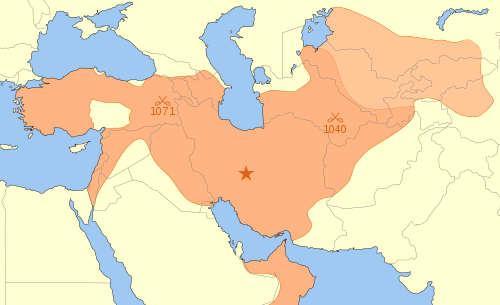
upon the death of Malik Shah I.
Status
Empire
Capital
Nishapur
(1037–1043)
Ray
(1043–1051)
Isfahan
(1051–1118)
Merv, Eastern capital (1118–1153)
Hamadan, Western capital (1118–1194)
Common languages
Persian (official and court; literature and lingua franca)[1][2][3]
Oghuz Turkic (dynastic and military)[4][3][5]
Arabic (theology, law and science)[1][3]
Religion
Sunni Islam (Hanafi)
Government
De facto: Independent Sultanate
De jure: Under Caliphate[6]
Caliph
• 1031–1075
Al-Qa’im
• 1180–1225
Al-Nasir
Sultan
• 1037–1063
Toghrul I (first)
• 1174–1194
Toghrul III (last)[7]
History
• Tughril formed the state system
1037
• Battle of Dandanaqan
1040
• Battle of Manzikert
1071
• First Crusade
1095–1099
• Battle of Qatwan
1141
• Replaced by the Khwarezmian Empire[8]
1194
Area
1080 est.[9][10]
3,900,000 km2 (1,500,000 sq mi)
Preceded by Succeeded by
Oghuz Yabgu State
Ghaznavids
Buyid dynasty
Byzantine Empire
Kakuyids
Fatimid Caliphate
Kara-Khanid Khanate
Marwanids
Rawadids
Sultanate of Rûm
Anatolian beyliks
Ghurid Dynasty
Khwarezmian Empire
Atabegs of Azerbaijan
Salghurids
Bavandids
Ayyubid dynasty
Burid dynasty
Zengid dynasty
Danishmends
Artuqid dynasty
Shah-Armens
Shaddadids
The Seljuk empire was founded by Tughril Beg (990–1063) and his brother Chaghri Beg (989–1060) in 1037. From their homelands near the Aral Sea, the Seljuks advanced first into Khorasan and then into mainland Persia, before eventually capturing Baghdad and conquering eastern Anatolia. Here the Seljuks won the battle of Manzikert in 1071 and conquered most of Anatolia from the Byzantine Empire, which became one of the reasons for the First Crusade (1095–1099). Starting from 1140s, the Seljuk empire declined, and was eventually replaced by the Khwarazmian Empire in 1194.
Seljuk gave his name to both the empire and the Seljuk dynasty. The Seljuks united the fractured political landscape of the eastern Islamic world and played a key role in the first and second crusades. Highly Persianized[16] in culture[17] and language,[18] the Seljuks also played an important role in the development of the Turko-Persian tradition,[19] even exporting Persian culture to Anatolia.[20][21] The settlement of Turkic tribes in the northwestern peripheral parts of the empire, for the strategic military purpose of fending off invasions from neighboring states, led to the progressive Turkicization of those areas.[22]
Founder of the dynasty
The apical ancestor of the Seljuks was their bey Seljuk. He was reputed to have served in the Khazar army, under whom, the Seljuks migrated to Khwarezm, near the city of Jend, where they converted to Islam in 985.[23] Khwarezm, administered by the Ma’munids, was under the nominal control of the Samanid Empire.[24] By 999 the Samanids fell to the Kara-Khanids in Transoxania, however, the Ghaznavids occupied the lands south of the Oxus.[25] The Seljuks became involved, having supported the last Samanid emir against the Kara-Khanids, in this power struggle in the region before establishing their own independent base.[26]
Expansion of the empire
Main articles: Seljuk dynasty, Persianate, and Turko-Persian tradition
Tughril and Chaghri
Main article: Tughril
The grandson of Seljuk, Tughril, under whom the Seljuks wrested an empire from the Ghaznavids. Initially the Seljuks were repulsed by Mahmud and retired to Khwarezm, but Tughril and Chaghri led them to capture Merv and Nishapur (1037/38).[27] Later they repeatedly raided and traded territory with his successor, Mas’ud, across Khorasan and Balkh.[28]
In 1040, at the Battle of Dandanaqan, they decisively defeated Mas’ud I of the Ghaznavids, forcing him to abandon most of his western territories to the Seljuks.[29] By 1046, the Caliph al-Qa’im had sent Tughril a diploma recognizing Seljuk rule over Khurasan.[30] In 1048–9, the Seljuk Turks commanded by Ibrahim Yinal, uterine brother of the sultan Tughril, made their first incursion in Byzantine frontier region of Iberia and clashed with a combined Byzantine-Georgian army of 50,000 at the Battle of Kapetrou on 10 September 1048. The devastation left behind by the Seljuk raid was so fearful that the Byzantine magnate Eustathios Boilas described, in 1051/52, those lands as “foul and unmanageable… inhabited by snakes, scorpions, and wild beasts.” The Arab chronicler Ibn al-Athir reports that Ibrahim brought back 100,000 captives and a vast booty loaded on the backs of ten thousand camels.[31] In 1055, Tughril entered Baghdad and removed the Shia Buyid influence, under a commission from the Abbasid Caliph.[30]
Alp Arslan
Main article: Alp Arslan
Alp Arslan, the son of Chaghri Beg, expanded significantly upon Tughril’s holdings by adding Armenia and Georgia in 1064 and invading the Byzantine Empire in 1068, from which he annexed almost all of Anatolia.[32] Arslan’s decisive victory at the Battle of Manzikert in 1071 effectively neutralized the Byzantine resistance to the Turkish invasion of Anatolia.[33] Although the Georgians were able to recover from Alp Arslan’s invasion by securing the theme of Iberia. The Byzantine withdrawal from Anatolia brought Georgia in more direct contact with the Seljuks. In 1073 the Seljuk Amirs of Ganja, Dvin and Dmanisi, invaded Georgia and were defeated by George II of Georgia, who successfully took the fortress of Kars.[34] A retaliatory strike by the Seljuk Amir Ahmad defeated the Georgians at Kvelistsikhe.[35]Alp Arslan authorized his Turkmen generals to carve their own principalities out of formerly Byzantine Anatolia, as atabegs loyal to him. Within two years the Turkmens had established control as far as the Aegean Sea under numerous beghliks (modern Turkish beyliks): the Saltukids in Northeastern Anatolia, the Shah-Armens and the Mengujekids in Eastern Anatolia, Artuqids in Southeastern Anatolia, Danishmendis in Central Anatolia, Rum Seljuks (Beghlik of Suleyman, which later moved to Central Anatolia) in Western Anatolia, and the Beylik of Tzachas of Smyrna in İzmir (Smyrna).[citation needed]
Malik Shah I
Main article: Malik Shah I
Under Alp Arslan’s successor, Malik Shah, and his two Persian viziers, Nizām al-Mulk and Tāj al-Mulk, the Seljuk state expanded in various directions, to the former Iranian border of the days before the Arab invasion, so that it soon bordered China in the east and the Byzantines in the west. Malikshāh was the one who moved the capital from Ray to Isfahan.[36] It was under his rule and leadership that the Saljūq Empire had reached the height of its successes.[37] The Iqta military system and the Nizāmīyyah University at Baghdad were established by Nizām al-Mulk, and the reign of Malikshāh was reckoned the golden age of “Great Seljuk”. The Abbasid Caliph titled him “The Sultan of the East and West” in 1087. The Assassins (Hashshashin) of Hassan-i Sabāh started to become a force during his era, however, and they assassinated many leading figures in his administration; according to many sources these victims included Nizām al-Mulk.[citation needed]in 1076 Malik Shah I surged into Georgia and reduced many settlements to ruins. from 1079/80 onward, Georgia was pressured into submitting to Malik-Shah to ensure a precious degree of peace at the price of an annual tribute.[citation needed]
Ahmad Sanjar
Main article: Ahmad Sanjar
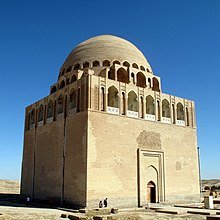
Ahmad was the son of Malik Shah I and initially took part in wars of succession against his three brothers and a nephew: Mahmud I, Barkiyaruq, Malik Shah II and Muhammad I Tapar. In 1096, he was tasked to govern the province of Khorasan by his brother Muhammad I.[38] Over the next several years, Ahmad Sanjar became the ruler of most of Iran (Persia), and eventually in 1118, the sole ruler of the Great Seljuk Empire.[39]
In 1141, Ahmad marched to eliminate the threat posed by Kara Khitans and faced them in the vicinity of Samarkand at the Battle of Qatwan. He suffered his first defeat in his long career, and as a result lost all Seljuk territory east of the Syr Darya.[40][41]
Sanjar’s as well as Seljuks’ rule collapsed as a consequence of yet another unexpected defeat, this time at the hands of the Seljuks’ own tribe, in 1153.[39] Sanjar was captured during the battle and held in captivity until 1156.[42] It brought chaos to the Empire – situation later exploited by the victorious Turkmens, whose hordes would overrun Khorasan unopposed, wreaking colossal damage on the province and prestige of Sanjar.[42] Sanjar eventually escaped from captivity in the fall of 1156, but soon died in Merv (present-day Turkmenistan), in 1157. After his death, Turkic rulers, Turkmen tribal forces, and other secondary powers competed for Khorasan, and after a long period of confrontations, the province was finally conquered by Khwarazmians in the early 1200s.[43]
Tomb of Ahmed Sanjar was destroyed by the Mongols led by Tolui, who sacked the city of Merv in 1221, killing 700,000 people according to contemporary sources during their catastrophic invasion of Khwarazm;[44] however, modern scholarship holds such figures to be exaggerated.[45][46]
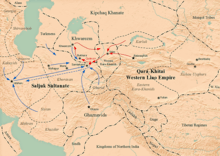
Ahmad Sanjar fought to contain the revolts by the Kara-Khanids in Transoxiana, Ghurids in Afghanistan and Qarluks in modern Kyrghyzstan, as well as the nomadic invasion of the Kara-Khitais in the east. The advancing Kara-Khitais first defeated the Eastern Kara-Khanids, then followed up by crushing the Western Kara-Khanids, who were vassals of the Seljuks at Khujand. The Kara-Khanids turned to their overlord the Seljuks for assistance, to which Sanjar responded by personally leading an army against the Kara-Khitai. However, Sanjar’s army was decisively defeated by the host of Yelu Dashi at the Battle of Qatwan on September 9, 1141. While Sanjar managed to escape with his life, many of his close kin including his wife were taken captive in the battle’s aftermath. As a result of Sanjar’s failure to deal with the encroaching threat from the east, the Seljuk Empire lost all its eastern provinces up to the river Syr Darya, and vassalage of the Western Kara-Khanids was usurped by the Kara-Khitai, otherwise known as the Western Liao in Chinese historiography.[51]
List of sultans of the Seljuk Empire
# Laqab Throne name Reign Marriages Succession right
1 Rukn ad-Dunya wa ad-Din
رکن الدنیا والدین, Toghrul-Beg 1037–1063 1) Altun Jan Khatun
(2) Aka Khatun
(3) Fulana Khatun
(daughter of Abu Kalijar)
(4) Seyyidah Khatun
(daughter of Al-Qa’im, Abbasid caliph)
(5) Fulana Khatun
(widow of Chaghri Beg) son of Mikail
(grandson of Seljuk)
2 Diya ad-Dunya wa ad-Din Adud ad-Dawlah
ضياء الدنيا و الدين عضد الدولة Alp Arslan 1063–1072 1) Aka Khatun
(widow of Toghrul I)
(2) Safariyya Khatun
(daughter of Yusuf Qadir Khan, Khagan of Kara-Khanid)
(3) Fulana Khatun
(daughter of Smbat Lorhi)
(4) Fulana Khatun
(daughter of Kurtchu bin Yunus bin Seljuk) son of Chaghri
3 Muizz ad-Dunya wa ad-Din Jalal ad-Dawlah
معز الدین جلال الدولہ Malik-Shah I 1072–1092 1) Turkan Khatun
(daughter of Ibrahim Tamghach Khan, Khagan of Western Kara-Khanid)
(2) Zubeida Khatun
(daughter of Yaquti ibn Chaghri)
(3) Safariyya Khatun
(daughter of Isa Khan, Sultan of Samarkand)
(4) Fulana Khatun
(daughter of Romanos IV Diogenes) son of Alp Arslan
4 Nasir ad-Dunya wa ad-Din
ناصر الدنیا والدین Mahmud I 1092–1094 son of Malik-Shah I
5 Rukn ad-Dunya wa ad-Din
رکن الدنیا والدین Barkiyaruq 1094–1105 son of Malik-Shah I
6 Rukn ad-Dunya wa ad-Din Jalal ad-Dawlah
رکن الدنیا والدین جلال الدولہ Malik-Shah II 1105 son of Barkiyaruq
7 Ghiyath ad-Dunya wa ad-Din
غیاث الدنیا والدین Tapar 1105–1118 1) Nisandar Jihan Khatun
(2) Gouhar Khatun
(daughter of Isma’il bin Yaquti)
(3) Fulana Khatun
(daughter of Aksungur Beg) son of Malik-Shah I
8 Mughith ad-Dunya wa ad-Din Jalal ad-Dawlah
مُغيث الدنيا و الدين جلال الدولة Mahmud II 1118–1131 1) Mah-i Mulk Khatun (died 1130)
(daughter of Sanjar)
(2) Amir Siti Khatun
(daughter of Sanjar)
(3) Ata Khatun
(daughter of Ali bin Faramarz) son of Muhammad I
9 Muizz ad-Dunya wa ad-Din Adud ad-Dawlah
مُعز الدنيا و الدين جلال الدولة Sanjar 1118–1153 1) Turkan Khatun
(daughter of Muhammad Arslan Khan, Khagan of Western Kara-Khanid)
(2) Rusudan Khatun
(daughter of Demetrius I of Georgia)
(3) Gouhar Khatun
(daughter of Isma’il bin Yaquti, widow of Tapar)
(4) Fulana Khatun
(daughter of Arslan Khan, a Qara Khitai prisoner) son of Malik-Shah I
10 Ghiyath ad-Dunya wa ad-Din
غیاث الدنیا والدین Dawud 1131–1132 Gouhar Khatun
(daughter of Masud) son of Mahmud II
11 Rukn ad-Dunya wa ad-Din
رکن الدنیا والدین Toghrul II 1132–1135 1) Mumine Khatun
(mother of Arslan-Shah)
(2) Zubeida Khatun
(daughter of Barkiyaruq) son of Muhammad I
12 Ghiyath ad-Dunya wa ad-Din
غیاث الدنیا والدین Masud 1135–1152 1) Gouhar Nasab Khatun
(daughter of Sanjar)
(2) Zubeida Khatun
(daughter of Barkiyaruq, widow of Toghrul II)
(3) Mustazhiriyya Khatun
(daughter of Qawurd)
(4) Sufra Khatun
(daughter of Dubais)
(5) Arab Khatun
(daughter of Al-Muqtafi)
(6) Ummiha Khatun
(daughter of Amid ud-Deula bin Juhair)
(7) Abkhaziyya Khatun
(daughter of David IV of Georgia)
(8) Sultan Khatun
(mother of Malik-Shah III) son of Muhammad I
13 Muin ad-Dunya wa ad-Din
مُعين الدنيا و الدين Malik-Shah III 1152–1153 son of Mahmud II
14 Rukn ad-Dunya wa ad-Din
رکن الدنیا والدین Muhammad 1153–1159 1) Mahd Rafi Khatun
(daughter of Kirman-Shah)
(2) Gouhar Khatun
(daughter of Masud, widow of Dawud)
(3) Kerman Khatun
(daughter of Al-Muqtafi)
(4) Kirmaniyya Khatun
(daughter of Tughrul Shah, ruler of Kerman) son of Mahmud II
15 Ghiyath ad-Dunya wa ad-Din
غیاث الدنیا والدین Suleiman-Shah 1159–1160 1) Khwarazmi Khatun
(daughter of Muhammad Khwarazm Shah)
(2) Abkhaziyya Khatun
(daughter of David IV of Georgia, widow of Masud) son of Muhammad I
16 Muizz ad-Dunya wa ad-Din
معز الدنیا والدین Arslan-Shah 1160–1176 1) Kerman Khatun
(daughter of Al-Muqtafi, widow of Muhammad)
(2) Sitti Fatima Khatun
(daughter of Ala ad-Daulah)
(3) Kirmaniyya Khatun
(daughter of Tughrul Shah, ruler of Kerman, widow of Muhammad)
(4) Fulana Khatun
(sister of Izz al-Din Hasan Qipchaq) son of Toghrul II
17 Rukn ad-Dunya wa ad-Din
رکن الدنیا والدین Toghrul III 1176–1191
1st reign Inanj Khatun
(daughter of Sunqur-Inanj, ruler of Ray, widow of Toghrul III) son of Arslan-Shah
18 Muzaffar ad-Dunya wa ad-Din
مظفر الدنیا والدین Qizil Arslan 1191 Inanj Khatun
(daughter of Sunqur-Inanj, ruler of Ray, widow of Muhammad ibn Ildeniz) son of Ildeniz
(stepbrother of Arslan-Shah)
— Rukn ad-Dunya wa ad-Din
رکن الدنیا والدین Toghrul III 1192–1194
2nd reign
 Site Title