Muhammad[n 1] (Arabic: مُحَمَّد, pronounced [muˈħammad];[n 2] c. 570 CE – 8 June 632 CE)[1] was an Arab religious, social, and political leader and the founder of Islam.[2] According to Islamic doctrine, he was a prophet, sent to preach and confirm the monotheistic teachings of Adam, Abraham, Moses, Jesus, and other prophets.[2][3][4][5] He is believed to be the final prophet of God in all the main branches of Islam, though some modern denominations diverge from this belief.[n 3] Muhammad united Arabia into a single Muslim polity, with the Quran as well as his teachings and practices forming the basis of Islamic religious belief
Islamic prophet
Muhammad
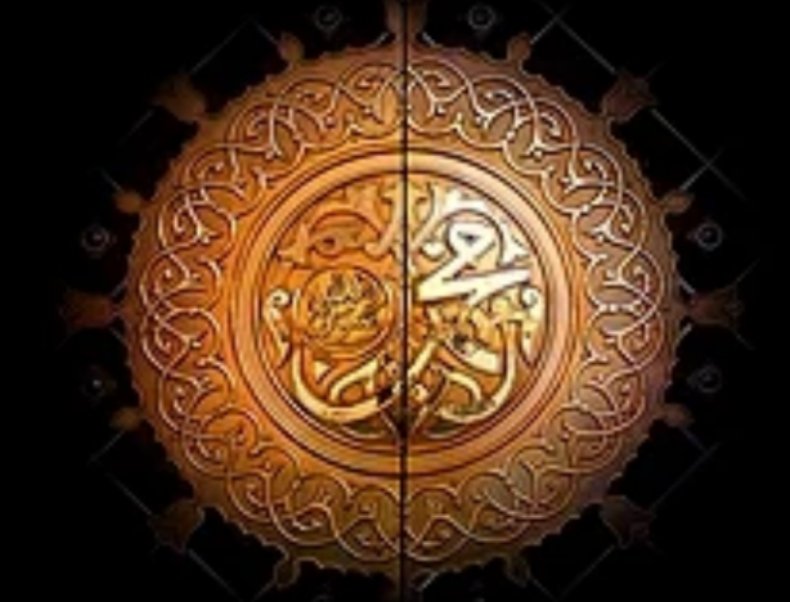
inscribed on the gates of the Prophet’s Mosque in Medina
Born
Muḥammad ibn ʿAbdullāh
(Arabic: مُحَمَّد بْن عَبْد ٱللَّٰه)
c. 570
Mecca, Hejaz, Arabia
Died
8 June 632 (aged 61–62)
Medina, Hejaz, Arabia
Resting place
Green Dome at al-Masjid an-Nabawi, Medina, Arabia
24°28′03″N 39°36′41″E
Other names
Abu al-Qasim (nickname)
Rasūl Allāh (Messenger of God)
(see Names and titles of Muhammad)
Years active
583–609 CE as merchant
609–632 CE as religious leader
Notable work
Constitution of Medina
Successor
See Succession to Muhammad
Opponent(s)
Quraysh
Spouse(s)
Muhammad’s wives Married
Khadija bint Khuwaylid 595–619
Sawda bint Zamʿa 619–632
Aisha bint Abi Bakr c. 623–632
Hafsa bint Umar 624–632
Zaynab bint Khuzayma 625–627
Hind bint Abi Umayya 625–632
Zaynab bint Jahsh 627–632
Juwayriyya bint al-Harith 628–632
Ramla bint Abi Sufyan 628–632
Rayhana bint Zayd 629–631
Safiyya bint Huyayy 629–632
Maymunah bint al-Harith 630–632
Maria al-Qibtiyya 630–632
Children
See Children of Muhammad
Parent(s)
Abdallah ibn Abd al-Muttalib (father)
Aminah bint Wahb (mother)
Relatives
Family tree of Muhammad, Ahl al-Bayt (“Family of the House”)Arabic name
Personal (Ism)
Muhammad
Patronymic (Nasab)
Muḥammad ibn Abd Allah ibn Abd al-Muttalib ibn Hashim ibn Abd Manaf ibn Qusai ibn Kilab
Teknonymic (Kunya)
Abu al-Qasim
Epithet (Laqab)
Khātam an-Nâbîyīn (Seal of the prophets)
Signature

S.W.A
Born approximately 570 CE (Year of the Elephant) in the Arabian city of Mecca, Muhammad was orphaned at the age of six.[6] He was raised under the care of his paternal grandfather Abd al-Muttalib, and upon his death, by his uncle Abu Talib.[7] In later years, he would periodically seclude himself in a mountain cave named Hira for several nights of prayer. When he was 40, Muhammad reported being visited by Gabriel in the cave[8][9] and receiving his first revelation from God. In 613,[10] Muhammad started preaching these revelations publicly,[11] proclaiming that “God is One”, that complete “submission” (islām) to God[12] is the right way of life (dīn),[13] and that he was a prophet and messenger of God, similar to the other prophets in Islam.[14][15][16]
Muhammad’s followers were initially few in number, and experienced hostility from Meccan polytheists. To escape ongoing persecution, he sent some of his followers to Abyssinia in 615, before he and his followers migrated from Mecca to Medina (then known as Yathrib) later in 622. This event, the Hijra, marks the beginning of the Islamic calendar, also known as the Hijri Calendar. In Medina, Muhammad united the tribes under the Constitution of Medina. In December 629, after eight years of intermittent fighting with Meccan tribes, Muhammad gathered an army of 10,000 Muslim converts and marched on the city of Mecca. The conquest went largely uncontested and Muhammad seized the city with little bloodshed. In 632, a few months after returning from the Farewell Pilgrimage, he fell ill and died. By the time of his death, most of the Arabian Peninsula had converted to Islam.[17][18]
The revelations (each known as Ayah – literally, “Sign [of God]”) that Muhammad reported receiving until his death form the verses of the Quran, regarded by Muslims as the verbatim “Word of God” on which the religion is based. Besides the Quran, Muhammad’s teachings and practices (sunnah), found in the Hadith and sira (biography) literature, are also upheld and used as sources of Islamic law (see Sharia).
Life
Timeline of Muhammad’s Life
Important dates and locations in the life of Muhammad
Date Age Event
c. 570 – Death of his father, Abdullah
c. 570 0 Possible date of birth: 12 or 17 Rabi al Awal: in Mecca, Arabia
c. 577 6 Death of his mother, Amina
c. 583 12–13 His grandfather transfers him to Syria
c. 595 24–25 Meets and marries Khadijah
c. 599 28–29 Birth of Zainab, his first daughter, followed by: Ruqayyah, Umm Kulthum, and Fatima Zahra
610 40 Qur’anic revelation begins in the Cave of Hira on the Jabal an-Nour, the “Mountain of Light” near Mecca. At age 40, Angel Jebreel (Gabriel) was said to appear to Muhammad on the mountain and call him “the Prophet of Allah”
Begins in secret to gather followers in Mecca
c. 613 43 Begins spreading message of Islam publicly to all Meccans
c. 614 43–44 Heavy persecution of Muslims begins
c. 615 44–45 Emigration of a group of Muslims to Ethiopia
c. 616 45–46 Banu Hashim clan boycott begins
619 49 Banu Hashim clan boycott ends
The year of sorrows: Khadija (his wife) and Abu Talib (his uncle) die
c. 620 49–50 Isra and Mi’raj (reported ascension to heaven to meet God)
622 51–52 Hijra, emigration to Medina (called Yathrib)
624 53–54 Battle of Badr
625 54–55 Battle of Uhud
627 56–57 Battle of the Trench (also known as the siege of Medina)
628 57–58 The Meccan tribe of Quraysh and the Muslim community in Medina signed a 10-year truce called the Treaty of Hudaybiyyah
630 59–60 Conquest of Mecca
632 61–62 Farewell pilgrimage, event of Ghadir Khumm, and death, in what is now Saudi Arabia
Childhood and early life
Abū al-Qāsim Muḥammad ibn ʿAbd Allāh ibn ʿAbd al-Muṭṭalib ibn Hāshim,[49] was born in Mecca[50] about the year 570[8] and his birthday is believed to be in the month of Rabi’ al-awwal.[51] He belonged to the Banu Hashim clan, part of the Quraysh tribe, which was one of Mecca’s prominent families, although it appears less prosperous during Muhammad’s early lifetime.[16][52] Tradition places the year of Muhammad’s birth as corresponding with the Year of the Elephant, which is named after the failed destruction of Mecca that year by the Abraha, Yemen’s king, who supplemented his army with elephants.[53][54][55] Alternatively some 20th century scholars have suggested different years, such as 568 or 569.[7]
Muhammad’s father, Abdullah, died almost six months before he was born.[57] According to Islamic tradition, soon after birth he was sent to live with a Bedouin family in the desert, as desert life was considered healthier for infants; some western scholars reject this tradition’s historicity.[58] Muhammad stayed with his foster-mother, Halimah bint Abi Dhuayb, and her husband until he was two years old. At the age of six, Muhammad lost his biological mother Amina to illness and became an orphan.[58][59] For the next two years, until he was eight years old, Muhammad was under the guardianship of his paternal grandfather Abdul-Muttalib, of the Banu Hashim clan until his death. He then came under the care of his uncle Abu Talib, the new leader of the Banu Hashim.[7] According to Islamic historian William Montgomery Watt there was a general disregard by guardians in taking care of weaker members of the tribes in Mecca during the 6th century, “Muhammad’s guardians saw that he did not starve to death, but it was hard for them to do more for him, especially as the fortunes of the clan of Hashim seem to have been declining at that time.”[60]
In his teens, Muhammad accompanied his uncle on Syrian trading journeys to gain experience in commercial trade.[60] Islamic tradition states that when Muhammad was either nine or twelve while accompanying the Meccans’ caravan to Syria, he met a Christian monk or hermit named Bahira who is said to have foreseen Muhammad’s career as a prophet of God.[61]
Little is known of Muhammad during his later youth as available information is fragmented, making it difficult to separate history from legend.[60] It is known that he became a merchant and “was involved in trade between the Indian Ocean and the Mediterranean Sea.”[62] Due to his upright character he acquired the nickname “al-Amin” (Arabic: الامين), meaning “faithful, trustworthy” and “al-Sadiq” meaning “truthful”[63] and was sought out as an impartial arbitrator.[9][16][64] His reputation attracted a proposal in 595 from Khadijah, a successful businesswoman. Muhammad consented to the marriage, which by all accounts was a happy one.[62]
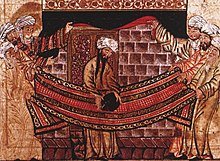
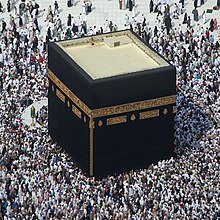
Several years later, according to a narration collected by historian Ibn Ishaq, Muhammad was involved with a well-known story about setting the Black Stone in place in the wall of the Kaaba in 605 CE. The Black Stone, a sacred object, was removed during renovations to the Kaaba. The Meccan leaders could not agree which clan should return the Black Stone to its place. They decided to ask the next man who comes through the gate to make that decision; that man was the 35-year-old Muhammad. This event happened five years before the first revelation by Gabriel to him. He asked for a cloth and laid the Black Stone in its center. The clan leaders held the corners of the cloth and together carried the Black Stone to the right spot, then Muhammad laid the stone, satisfying the honor of all.[65][66]
Beginnings of the Quran
Recite in the name of your Lord who created—Created man from a clinging substance. Recite, and your Lord is the most Generous—Who taught by the pen—Taught man that which he knew not.
Muhammad began to pray alone in a cave named Hira on Mount Jabal al-Nour, near Mecca for several weeks every year.[67][68] Islamic tradition holds that during one of his visits to that cave, in the year 610 the angel Gabriel appeared to him and commanded Muhammad to recite verses that would be included in the Quran.[69] Consensus exists that the first Quranic words revealed were the beginning of Quran 96:1.[70] Muhammad was deeply distressed upon receiving his first revelations. After returning home, Muhammad was consoled and reassured by Khadijah and her Christian cousin, Waraka ibn Nawfal.[71] He also feared that others would dismiss his claims as being possessed.[39] Shi’a tradition states Muhammad was not surprised or frightened at Gabriel’s appearance; rather he welcomed the angel, as if he was expected.[72] The initial revelation was followed by a three-year pause (a period known as fatra) during which Muhammad felt depressed and further gave himself to prayers and spiritual practices.[70] When the revelations resumed he was reassured and commanded to begin preaching: “Thy Guardian-Lord hath not forsaken thee, nor is He displeased.”[73][74][75]

Sahih Bukhari narrates Muhammad describing his revelations as “sometimes it is (revealed) like the ringing of a bell”. Aisha reported, “I saw the Prophet being inspired Divinely on a very cold day and noticed the sweat dropping from his forehead (as the Inspiration was over)”.[76] According to Welch these descriptions may be considered genuine, since they are unlikely to have been forged by later Muslims.[16] Muhammad was confident that he could distinguish his own thoughts from these messages.[77] According to the Quran, one of the main roles of Muhammad is to warn the unbelievers of their eschatological punishment (Quran 38:70,[78] Quran 6:19).[79] Occasionally the Quran did not explicitly refer to Judgment day but provided examples from the history of extinct communities and warns Muhammad’s contemporaries of similar calamities (Quran 41:13–16).[80] Muhammad did not only warn those who rejected God’s revelation, but also dispensed good news for those who abandoned evil, listening to the divine words and serving God.[81] Muhammad’s mission also involves preaching monotheism: The Quran commands Muhammad to proclaim and praise the name of his Lord and instructs him not to worship idols or associate other deities with God.[80]
The key themes of the early Quranic verses included the responsibility of man towards his creator; the resurrection of the dead, God’s final judgment followed by vivid descriptions of the tortures in Hell and pleasures in Paradise, and the signs of God in all aspects of life. Religious duties required of the believers at this time were few: belief in God, asking for forgiveness of sins, offering frequent prayers, assisting others particularly those in need, rejecting cheating and the love of wealth (considered to be significant in the commercial life of Mecca), being chaste and not committing female infanticide.[16]
Opposition
According to Muslim tradition, Muhammad’s wife Khadija was the first to believe he was a prophet.[82] She was followed by Muhammad’s ten-year-old cousin Ali ibn Abi Talib, close friend Abu Bakr, and adopted son Zaid.[82] Around 613, Muhammad began to preach to the public (Quran 26:214).[11][83] Most Meccans ignored and mocked him, though a few became his followers. There were three main groups of early converts to Islam: younger brothers and sons of great merchants; people who had fallen out of the first rank in their tribe or failed to attain it; and the weak, mostly unprotected foreigners.[84]
According to Ibn Saad, opposition in Mecca started when Muhammad delivered verses that condemned idol worship and the polytheism practiced by the Meccan forefathers.[85] However, the Quranic exegesis maintains that it began as Muhammad started public preaching.[86] As his followers increased, Muhammad became a threat to the local tribes and rulers of the city, whose wealth rested upon the Ka’aba, the focal point of Meccan religious life that Muhammad threatened to overthrow. Muhammad’s denunciation of the Meccan traditional religion was especially offensive to his own tribe, the Quraysh, as they were the guardians of the Ka’aba.[84] Powerful merchants attempted to convince Muhammad to abandon his preaching; he was offered admission to the inner circle of merchants, as well as an advantageous marriage. He refused both of these offers.[84]
Have We not made for him two eyes? And a tongue and two lips? And have shown him the two ways? But he has not broken through the difficult pass. And what can make you know what is the difficult pass? It is the freeing of a slave. Or feeding on a day of severe hunger; an orphan of near relationship, or a needy person in misery. And then being among those who believed and advised one another to patience and advised one another to mercy.
— Quran (90:8–17)
Tradition records at great length the persecution and ill-treatment towards Muhammad and his followers.[16] Sumayyah bint Khayyat, a slave of a prominent Meccan leader Abu Jahl, is famous as the first martyr of Islam; killed with a spear by her master when she refused to give up her faith. Bilal, another Muslim slave, was tortured by Umayyah ibn Khalaf who placed a heavy rock on his chest to force his conversion.[87][88]
In 615, some of Muhammad’s followers emigrated to the Ethiopian Kingdom of Aksum and founded a small colony under the protection of the Christian Ethiopian emperor Aṣḥama ibn Abjar.[16] Ibn Sa’ad mentions two separate migrations. According to him, most of the Muslims returned to Mecca prior to Hijra, while a second group rejoined them in Medina. Ibn Hisham and Tabari, however, only talk about one migration to Ethiopia. These accounts agree that Meccan persecution played a major role in Muhammad’s decision to suggest that a number of his followers seek refuge among the Christians in Abyssinia. According to the famous letter of ʿUrwa preserved in al-Tabari, the majority of Muslims returned to their native town as Islam gained strength and high ranking Meccans, such as Umar and Hamzah converted.[89]
However, there is a completely different story on the reason why the Muslims returned from Ethiopia to Mecca. According to this account—initially mentioned by Al-Waqidi then rehashed by Ibn Sa’ad and Tabari, but not by Ibn Hisham and not by Ibn Ishaq[90]—Muhammad, desperately hoping for an accommodation with his tribe, pronounced a verse acknowledging the existence of three Meccan goddesses considered to be the daughters of Allah. Muhammad retracted the verses the next day at the behest of Gabriel, claiming that the verses were whispered by the devil himself. Instead, a ridicule of these gods was offered.[91][n 4][n 5] This episode, known as “The Story of the Cranes,” is also known as “Satanic Verses”. According to the story, this led to a general reconciliation between Muhammad and the Meccans, and the Abyssinia Muslims began to return home. When they arrived Gabriel had informed Muhammad that the two verses were not part of the revelation, but had been inserted by Satan. Notable scholars at the time argued against the historic authenticity of these verses and the story itself on various grounds.[92][93][n 6] Al-Waqidi was severely criticized by Islamic scholars such as Malik ibn Anas, al-Shafi’i, Ahmad ibn Hanbal, Al-Nasa’i, al-Bukhari, Abu Dawood, Al-Nawawi and others as a liar and forger.[94][95][96][97] Later, the incident received some acceptance among certain groups, though strong objections to it continued onwards past the tenth century. The objections continued until rejection of these verses and the story itself eventually became the only acceptable orthodox Muslim position.[98]
In 616 (or 617), the leaders of Makhzum and Banu Abd-Shams, two important Quraysh clans, declared a public boycott against Banu Hashim, their commercial rival, to pressure it into withdrawing its protection of Muhammad. The boycott lasted three years but eventually collapsed as it failed in its objective.[99][100] During this time, Muhammad was able to preach only during the holy pilgrimage months in which all hostilities between Arabs were suspended.
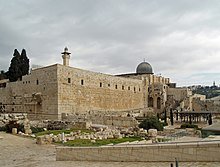
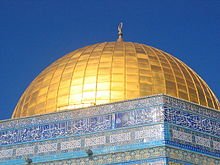
Islamic tradition states that in 620, Muhammad experienced the Isra and Mi’raj, a miraculous night-long journey said to have occurred with the angel Gabriel. At the journey’s beginning, the Isra, he is said to have traveled from Mecca on a winged steed to “the farthest mosque.” Later, during the Mi’raj, Muhammad is said to have toured heaven and hell, and spoke with earlier prophets, such as Abraham, Moses, and Jesus.[102] Ibn Ishaq, author of the first biography of Muhammad, presents the event as a spiritual experience; later historians, such as Al-Tabari and Ibn Kathir, present it as a physical journey.[102]
Some western scholars[who?] hold that the Isra and Mi’raj journey traveled through the heavens from the sacred enclosure at Mecca to the celestial al-Baytu l-Maʿmur (heavenly prototype of the Kaaba); later traditions indicate Muhammad’s journey as having been from Mecca to Jerusalem.[103][page needed]
Last years before Hijra
Muhammad’s wife Khadijah and uncle Abu Talib both died in 619, the year thus being known as the “Year of Sorrow”. With the death of Abu Talib, leadership of the Banu Hashim clan passed to Abu Lahab, a tenacious enemy of Muhammad. Soon afterward, Abu Lahab withdrew the clan’s protection over Muhammad. This placed Muhammad in danger; the withdrawal of clan protection implied that blood revenge for his killing would not be exacted. Muhammad then visited Ta’if, another important city in Arabia, and tried to find a protector, but his effort failed and further brought him into physical danger.[16][100] Muhammad was forced to return to Mecca. A Meccan man named Mut’im ibn Adi (and the protection of the tribe of Banu Nawfal) made it possible for him to safely re-enter his native city.[16][100]
Many people visited Mecca on business or as pilgrims to the Kaaba. Muhammad took this opportunity to look for a new home for himself and his followers. After several unsuccessful negotiations, he found hope with some men from Yathrib (later called Medina).[16] The Arab population of Yathrib were familiar with monotheism and were prepared for the appearance of a prophet because a Jewish community existed there.[16] They also hoped, by the means of Muhammad and the new faith, to gain supremacy over Mecca; the Yathrib were jealous of its importance as the place of pilgrimage. Converts to Islam came from nearly all Arab tribes in Medina; by June of the subsequent year, seventy-five Muslims came to Mecca for pilgrimage and to meet Muhammad. Meeting him secretly by night, the group made what is known as the “Second Pledge of al-‘Aqaba”, or, in Orientalists’ view, the “Pledge of War”.[105] Following the pledges at Aqabah, Muhammad encouraged his followers to emigrate to Yathrib. As with the migration to Abyssinia, the Quraysh attempted to stop the emigration. However, almost all Muslims managed to leave.[106]
Hijra
Timeline of Muhammad in Medina
Important events in the life of Muhammad from 622 to 632
Date Age Event
622 51–52 Emigrates to Medina (Hijra)
623 52–53 Caravan Raids begin
624 53–54 Battle of Badr: Muslims defeat Meccans
Invasion of Banu Qaynuqa
Invasion of Sawiq
Al Kudr Invasion
Raid on Dhu Amarr, Muhammad raids Ghatafan tribes
625 54–55 Battle of Uhud: Meccans defeat Muslims
Invasion of Hamra al-Asad, successfully terrifies enemy to cause retreat
Assassination of Khaled b. Sufyan
Tragedy of al Raji and Bir Maona
Banu Nadir expelled after Invasion
626 55–56 Expedition of Badr al-Maw’id, Dhat al-Riqa and Dumat al-Jandal
627 56–57 Battle of the Trench
Invasion of Banu Qurayza, successful siege
628 57–58 Treaty of Hudaybiyyah, gains access to Kaaba
Conquest of the Khaybar oasis
629 58–59 First hajj pilgrimage
Attack on Byzantine Empire fails: Battle of Mu’tah
630 59–60 Bloodless conquest of Mecca
Battle of Hunayn
Siege of Ta’if
Attack on Byzantine Empire successful: Expedition of Tabuk
631 60–61 Rules most of the Arabian peninsula
632 61–62 Farewell hajj pilgrimage
Death, on June 8 in Medina
The Hijra is the migration of Muhammad and his followers from Mecca to Medina in 622 CE. In June 622, warned of a plot to assassinate him, Muhammad secretly slipped out of Mecca and moved his followers to Medina,[107] 450 kilometres (280 miles) north of Mecca.[108]
Migration to Medina
Main article: Muhammad in Medina
A delegation, consisting of the representatives of the twelve important clans of Medina, invited Muhammad to serve as chief arbitrator for the entire community; due to his status as a neutral outsider.[109][110] There was fighting in Yathrib: primarily the dispute involved its Arab and Jewish inhabitants, and was estimated to have lasted for around a hundred years before 620.[109] The recurring slaughters and disagreements over the resulting claims, especially after the Battle of Bu’ath in which all clans were involved, made it obvious to them that the tribal concept of blood-feud and an eye for an eye were no longer workable unless there was one man with authority to adjudicate in disputed cases.[109] The delegation from Medina pledged themselves and their fellow-citizens to accept Muhammad into their community and physically protect him as one of themselves.[16]
Muhammad instructed his followers to emigrate to Medina, until nearly all his followers left Mecca. Being alarmed at the departure, according to tradition, the Meccans plotted to assassinate Muhammad. With the help of Ali, Muhammad fooled the Meccans watching him, and secretly slipped away from the town with Abu Bakr.[111] By 622, Muhammad emigrated to Medina, a large agricultural oasis. Those who migrated from Mecca along with Muhammad became known as muhajirun (emigrants).[16]
Establishment of a new polity
Among the first things Muhammad did to ease the longstanding grievances among the tribes of Medina was to draft a document known as the Constitution of Medina, “establishing a kind of alliance or federation” among the eight Medinan tribes and Muslim emigrants from Mecca; this specified rights and duties of all citizens, and the relationship of the different communities in Medina (including the Muslim community to other communities, specifically the Jews and other “Peoples of the Book”).[109][110] The community defined in the Constitution of Medina, Ummah, had a religious outlook, also shaped by practical considerations and substantially preserved the legal forms of the old Arab tribes.[16]
The first group of converts to Islam in Medina were the clans without great leaders; these clans had been subjugated by hostile leaders from outside.[112] This was followed by the general acceptance of Islam by the pagan population of Medina, with some exceptions. According to Ibn Ishaq, this was influenced by the conversion of Sa’d ibn Mu’adh (a prominent Medinan leader) to Islam.[113] Medinans who converted to Islam and helped the Muslim emigrants find shelter became known as the ansar (supporters).[16] Then Muhammad instituted brotherhood between the emigrants and the supporters and he chose Ali as his own brother.[114]
Beginning of armed conflict
Main article: Battle of Badr
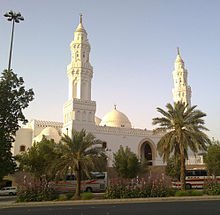
Following the emigration, the people of Mecca seized property of Muslim emigrants to Medina.[115] War would later break out between the people of Mecca and the Muslims. Muhammad delivered Quranic verses permitting Muslims to fight the Meccans (see sura Al-Hajj, Quran 22:39–40).[116] According to the traditional account, on 11 February 624, while praying in the Masjid al-Qiblatayn in Medina, Muhammad received revelations from God that he should be facing Mecca rather than Jerusalem during prayer. Muhammad adjusted to the new direction, and his companions praying with him followed his lead, beginning the tradition of facing Mecca during prayer.[117]
Permission has been given to those who are being fought, because they were wronged. And indeed, Allah is competent to give them victory. Those who have been evicted from their homes without right—only because they say, “Our Lord is Allah.” And were it not that Allah checks the people, some by means of others, there would have been demolished monasteries, churches, synagogues, and mosques in which the name of Allah is much mentioned. And Allah will surely support those who support Him. Indeed, Allah is Powerful and Exalted in Might.
— Quran (22:39–40)
Muhammad ordered a number of raids to capture Meccan caravans, but only the 8th of them, the Raid of Nakhla, resulted in actual fighting and capture of booty and prisoners.[118] In March 624, Muhammad led some three hundred warriors in a raid on a Meccan merchant caravan. The Muslims set an ambush for the caravan at Badr.[119] Aware of the plan, the Meccan caravan eluded the Muslims. A Meccan force was sent to protect the caravan and went on to confront the Muslims upon receiving word that the caravan was safe. The Battle of Badr commenced.[120] Though outnumbered more than three to one, the Muslims won the battle, killing at least forty-five Meccans with fourteen Muslims dead. They also succeeded in killing many Meccan leaders, including Abu Jahl.[121] Seventy prisoners had been acquired, many of whom were ransomed.[122][123][124] Muhammad and his followers saw the victory as confirmation of their faith[16] and Muhammad ascribed the victory to the assistance of an invisible host of angels. The Quranic verses of this period, unlike the Meccan verses, dealt with practical problems of government and issues like the distribution of spoils.[125]
The victory strengthened Muhammad’s position in Medina and dispelled earlier doubts among his followers.[126] As a result, the opposition to him became less vocal. Pagans who had not yet converted were very bitter about the advance of Islam. Two pagans, Asma bint Marwan of the Aws Manat tribe and Abu ‘Afak of the ‘Amr b. ‘Awf tribe, had composed verses taunting and insulting the Muslims.[127] They were killed by people belonging to their own or related clans, and Muhammad did not disapprove of the killings.[127] This report, however, is considered by some to be a fabrication.[128] Most members of those tribes converted to Islam, and little pagan opposition remained.[129]
Muhammad expelled from Medina the Banu Qaynuqa, one of three main Jewish tribes,[16] but some historians contend that the expulsion happened after Muhammad’s death.[130] According to al-Waqidi, after Abd-Allah ibn Ubaiy spoke for them, Muhammad refrained from executing them and commanded that they be exiled from Medina.[131] Following the Battle of Badr, Muhammad also made mutual-aid alliances with a number of Bedouin tribes to protect his community from attacks from the northern part of Hejaz.[16]
Conflict with Mecca
Main article: Battle of Uhud
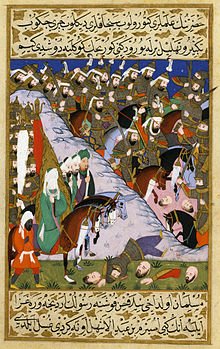
The Meccans were eager to avenge their defeat. To maintain economic prosperity, the Meccans needed to restore their prestige, which had been reduced at Badr.[132] In the ensuing months, the Meccans sent ambush parties to Medina while Muhammad led expeditions against tribes allied with Mecca and sent raiders onto a Meccan caravan.[133] Abu Sufyan gathered an army of 3000 men and set out for an attack on Medina.[134]
A scout alerted Muhammad of the Meccan army’s presence and numbers a day later. The next morning, at the Muslim conference of war, a dispute arose over how best to repel the Meccans. Muhammad and many senior figures suggested it would be safer to fight within Medina and take advantage of the heavily fortified strongholds. Younger Muslims argued that the Meccans were destroying crops, and huddling in the strongholds would destroy Muslim prestige. Muhammad eventually conceded to the younger Muslims and readied the Muslim force for battle. Muhammad led his force outside to the mountain of Uhud (the location of the Meccan camp) and fought the Battle of Uhud on 23 March 625.[135][136] Although the Muslim army had the advantage in early encounters, lack of discipline on the part of strategically placed archers led to a Muslim defeat; 75 Muslims were killed, including Hamza, Muhammad’s uncle who became one of the best known martyrs in the Muslim tradition. The Meccans did not pursue the Muslims; instead, they marched back to Mecca declaring victory. The announcement is probably because Muhammad was wounded and thought dead. When they discovered that Muhammad lived, the Meccans did not return due to false information about new forces coming to his aid. The attack had failed to achieve their aim of completely destroying the Muslims.[137][138] The Muslims buried the dead and returned to Medina that evening. Questions accumulated about the reasons for the loss; Muhammad delivered Quranic verses 3:152 indicating that the defeat was twofold: partly a punishment for disobedience, partly a test for steadfastness.[139]
Abu Sufyan directed his effort towards another attack on Medina. He gained support from the nomadic tribes to the north and east of Medina; using propaganda about Muhammad’s weakness, promises of booty, memories of Quraysh prestige and through bribery.[140] Muhammad’s new policy was to prevent alliances against him. Whenever alliances against Medina were formed, he sent out expeditions to break them up.[140] Muhammad heard of men massing with hostile intentions against Medina, and reacted in a severe manner.[141] One example is the assassination of Ka’b ibn al-Ashraf, a chieftain of the Jewish tribe of Banu Nadir. Al-Ashraf went to Mecca and wrote poems that roused the Meccans’ grief, anger and desire for revenge after the Battle of Badr.[142][143] Around a year later, Muhammad expelled the Banu Nadir from Medina[144] forcing their emigration to Syria; he allowed them to take some possessions, as he was unable to subdue the Banu Nadir in their strongholds. The rest of their property was claimed by Muhammad in the name of God as it was not gained with bloodshed. Muhammad surprised various Arab tribes, individually, with overwhelming force, causing his enemies to unite to annihilate him. Muhammad’s attempts to prevent a confederation against him were unsuccessful, though he was able to increase his own forces and stopped many potential tribes from joining his enemies.[145]
Siege of Medina
Main article: Battle of the Trench
With the help of the exiled Banu Nadir, the Quraysh military leader Abu Sufyan mustered a force of 10,000 men. Muhammad prepared a force of about 3,000 men and adopted a form of defense unknown in Arabia at that time; the Muslims dug a trench wherever Medina lay open to cavalry attack. The idea is credited to a Persian convert to Islam, Salman the Persian. The siege of Medina began on 31 March 627 and lasted two weeks.[146] Abu Sufyan’s troops were unprepared for the fortifications, and after an ineffectual siege, the coalition decided to return home.[147] The Quran discusses this battle in sura Al-Ahzab, in verses 33:9–27.[86] During the battle, the Jewish tribe of Banu Qurayza, located to the south of Medina, entered into negotiations with Meccan forces to revolt against Muhammad. Although the Meccan forces were swayed by suggestions that Muhammad was sure to be overwhelmed, they desired reassurance in case the confederacy was unable to destroy him. No agreement was reached after prolonged negotiations, partly due to sabotage attempts by Muhammad’s scouts.[148] After the coalition’s retreat, the Muslims accused the Banu Qurayza of treachery and besieged them in their forts for 25 days. The Banu Qurayza eventually surrendered; according to Ibn Ishaq, all the men apart from a few converts to Islam were beheaded, while the women and children were enslaved.[149][150] Walid N. Arafat and Barakat Ahmad have disputed the accuracy of Ibn Ishaq’s narrative.[151] Arafat believes that Ibn Ishaq’s Jewish sources, speaking over 100 years after the event, conflated this account with memories of earlier massacres in Jewish history; he notes that Ibn Ishaq was considered an unreliable historian by his contemporary Malik ibn Anas, and a transmitter of “odd tales” by the later Ibn Hajar.[152] Ahmad argues that only some of the tribe were killed, while some of the fighters were merely enslaved.[153][154] Watt finds Arafat’s arguments “not entirely convincing”, while Meir J. Kister has contradicted[clarification needed] the arguments of Arafat and Ahmad.[155]
In the siege of Medina, the Meccans exerted the available strength to destroy the Muslim community. The failure resulted in a significant loss of prestige; their trade with Syria vanished.[156] Following the Battle of the Trench, Muhammad made two expeditions to the north, both ended without any fighting.[16] While returning from one of these journeys (or some years earlier according to other early accounts), an accusation of adultery was made against Aisha, Muhammad’s wife. Aisha was exonerated from accusations when Muhammad announced he had received a revelation confirming Aisha’s innocence and directing that charges of adultery be supported by four eyewitnesses (sura 24, An-Nur).[157]
In your name, O God!
This is the treaty of peace between Muhammad Ibn Abdullah and Suhayl Ibn Amr. They have agreed to allow their arms to rest for ten years. During this time each party shall be secure, and neither shall injure the other; no secret damage shall be inflicted, but honesty and honour shall prevail between them. Whoever in Arabia wishes to enter into a treaty or covenant with Muhammad can do so, and whoever wishes to enter into a treaty or covenant with the Quraysh can do so. And if a Qurayshite comes without the permission of his guardian to Muhammad, he shall be delivered up to the Quraysh; but if, on the other hand, one of Muhammad’s people comes to the Quraysh, he shall not be delivered up to Muhammad. This year, Muhammad, with his companions, must withdraw from Mecca, but next year, he may come to Mecca and remain for three days, yet without their weapons except those of a traveller; the swords remaining in their sheaths.”
—The statement of the treaty of Hudaybiyyah[158]
Although Muhammad had delivered Quranic verses commanding the Hajj,[159] the Muslims had not performed it due to Quraysh enmity. In the month of Shawwal 628, Muhammad ordered his followers to obtain sacrificial animals and to prepare for a pilgrimage (umrah) to Mecca, saying that God had promised him the fulfillment of this goal in a vision when he was shaving his head after completion of the Hajj.[160] Upon hearing of the approaching 1,400 Muslims, the Quraysh dispatched 200 cavalry to halt them. Muhammad evaded them by taking a more difficult route, enabling his followers to reach al-Hudaybiyya just outside Mecca.[161] According to Watt, although Muhammad’s decision to make the pilgrimage was based on his dream, he was also demonstrating to the pagan Meccans that Islam did not threaten the prestige of the sanctuaries, that Islam was an Arabian religion.[161]
Negotiations commenced with emissaries traveling to and from Mecca. While these continued, rumors spread that one of the Muslim negotiators, Uthman bin al-Affan, had been killed by the Quraysh. Muhammad called upon the pilgrims to make a pledge not to flee (or to stick with Muhammad, whatever decision he made) if the situation descended into war with Mecca. This pledge became known as the “Pledge of Acceptance” or the “Pledge under the Tree”. News of Uthman’s safety allowed for negotiations to continue, and a treaty scheduled to last ten years was eventually signed between the Muslims and Quraysh.[161][163] The main points of the treaty included: cessation of hostilities, the deferral of Muhammad’s pilgrimage to the following year, and agreement to send back any Meccan who emigrated to Medina without permission from their protector.[161]
Many Muslims were not satisfied with the treaty. However, the Quranic sura “Al-Fath” (The Victory) (Quran 48:1–29) assured them that the expedition must be considered a victorious one.[164] It was later that Muhammad’s followers realized the benefit behind the treaty. These benefits included the requirement of the Meccans to identify Muhammad as an equal, cessation of military activity allowing Medina to gain strength, and the admiration of Meccans who were impressed by the pilgrimage rituals.[16]
After signing the truce, Muhammad assembled an expedition against the Jewish oasis of Khaybar, known as the Battle of Khaybar. This was possibly due to housing the Banu Nadir who were inciting hostilities against Muhammad, or to regain prestige from what appeared as the inconclusive result of the truce of Hudaybiyya.[134][165] According to Muslim tradition, Muhammad also sent letters to many rulers, asking them to convert to Islam (the exact date is given variously in the sources).[16][166][167] He sent messengers (with letters) to Heraclius of the Byzantine Empire (the eastern Roman Empire), Khosrau of Persia, the chief of Yemen and to some others.[166][167] In the years following the truce of Hudaybiyya, Muhammad directed his forces against the Arabs on Transjordanian Byzantine soil in the Battle of Mu’tah.[168]
Final years
Conquest of Mecca
The truce of Hudaybiyyah was enforced for two years.[169][170] The tribe of Banu Khuza’a had good relations with Muhammad, whereas their enemies, the Banu Bakr, had allied with the Meccans.[169][170] A clan of the Bakr made a night raid against the Khuza’a, killing a few of them.[169][170] The Meccans helped the Banu Bakr with weapons and, according to some sources, a few Meccans also took part in the fighting.[169] After this event, Muhammad sent a message to Mecca with three conditions, asking them to accept one of them. These were: either the Meccans would pay blood money for the slain among the Khuza’ah tribe, they disavow themselves of the Banu Bakr, or they should declare the truce of Hudaybiyyah null.[171]
The Meccans replied that they accepted the last condition.[171] Soon they realized their mistake and sent Abu Sufyan to renew the Hudaybiyyah treaty, a request that was declined by Muhammad.
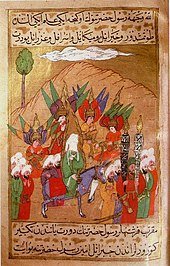
Muhammad began to prepare for a campaign.[172] In 630, Muhammad marched on Mecca with 10,000 Muslim converts. With minimal casualties, Muhammad seized control of Mecca.[173] He declared an amnesty for past offences, except for ten men and women who were “guilty of murder or other offences or had sparked off the war and disrupted the peace”.[174] Some of these were later pardoned.[175] Most Meccans converted to Islam and Muhammad proceeded to destroy all the statues of Arabian gods in and around the Kaaba.[176][177] According to reports collected by Ibn Ishaq and al-Azraqi, Muhammad personally spared paintings or frescos of Mary and Jesus, but other traditions suggest that all pictures were erased.[178] The Quran discusses the conquest of Mecca.[86][179
Conquest of Arabia
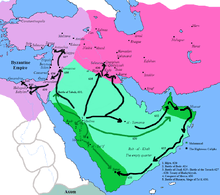
Following the conquest of Mecca, Muhammad was alarmed by a military threat from the confederate tribes of Hawazin who were raising an army double the size of Muhammad’s. The Banu Hawazin were old enemies of the Meccans. They were joined by the Banu Thaqif (inhabiting the city of Ta’if) who adopted an anti-Meccan policy due to the decline of the prestige of Meccans.[180] Muhammad defeated the Hawazin and Thaqif tribes in the Battle of Hunayn.[16]
In the same year, Muhammad organized an attack against northern Arabia because of their previous defeat at the Battle of Mu’tah and reports of hostility adopted against Muslims. With great difficulty he assembled 30,000 men; half of whom on the second day returned with Abd-Allah ibn Ubayy, untroubled by the damning verses which Muhammad hurled at them. Although Muhammad did not engage with hostile forces at Tabuk, he received the submission of some local chiefs of the region.[16][181]
He also ordered the destruction of any remaining pagan idols in Eastern Arabia. The last city to hold out against the Muslims in Western Arabia was Taif. Muhammad refused to accept the city’s surrender until they agreed to convert to Islam and allowed men to destroy the statue of their goddess Al-Lat.[118][182][183]
A year after the Battle of Tabuk, the Banu Thaqif sent emissaries to surrender to Muhammad and adopt Islam. Many bedouins submitted to Muhammad to safeguard against his attacks and to benefit from the spoils of war.[16] However, the bedouins were alien to the system of Islam and wanted to maintain independence: namely their code of virtue and ancestral traditions. Muhammad required a military and political agreement according to which they “acknowledge the suzerainty of Medina, to refrain from attack on the Muslims and their allies, and to pay the Zakat, the Muslim religious levy.”[184]
Farewell pilgrimage
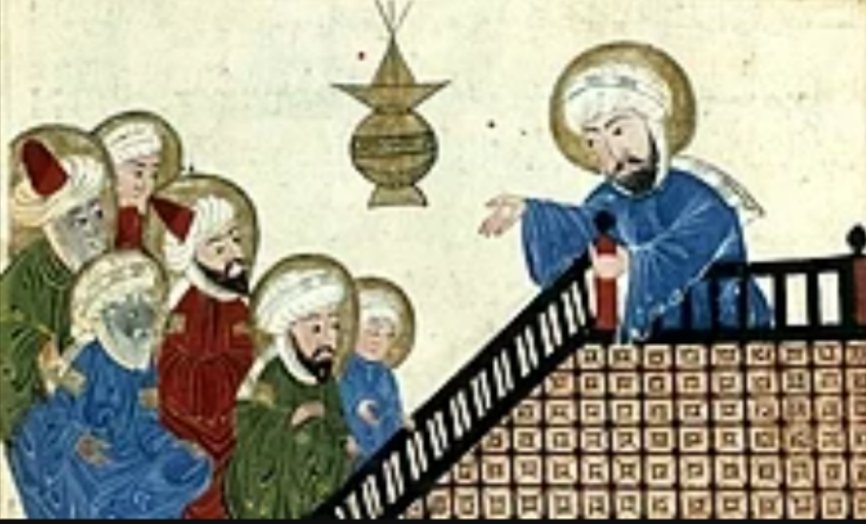
n 632, at the end of the tenth year after migration to Medina, Muhammad completed his first true Islamic pilgrimage, setting precedent for the annual Great Pilgrimage, known as Hajj.[16] On the 9th of Dhu al-Hijjah Muhammad delivered his Farewell Sermon, at Mount Arafat east of Mecca. In this sermon, Muhammad advised his followers not to follow certain pre-Islamic customs. For instance, he said a white has no superiority over a black, nor a black any superiority over a white except by piety and good action.[185] He abolished old blood feuds and disputes based on the former tribal system and asked for old pledges to be returned as implications of the creation of the new Islamic community. Commenting on the vulnerability of women in his society, Muhammad asked his male followers to “be good to women, for they are powerless captives (awan) in your households. You took them in God’s trust, and legitimated your sexual relations with the Word of God, so come to your senses people, and hear my words …” He told them that they were entitled to discipline their wives but should do so with kindness. He addressed the issue of inheritance by forbidding false claims of paternity or of a client relationship to the deceased and forbade his followers to leave their wealth to a testamentary heir. He also upheld the sacredness of four lunar months in each year.[186][187] According to Sunni tafsir, the following Quranic verse was delivered during this event: “Today I have perfected your religion, and completed my favours for you and chosen Islam as a religion for you” (Quran 5:3).[16] According to Shia tafsir, it refers to the appointment of Ali ibn Abi Talib at the pond of Khumm as Muhammad’s successor, this occurring a few days later when Muslims were returning from Mecca to Medina.[188]
Death and tomb
A few months after the farewell pilgrimage, Muhammad fell ill and suffered for several days with fever, head pain, and weakness. He died on Monday, 8 June 632, in Medina, at the age of 62 or 63, in the house of his wife Aisha.[189] With his head resting on Aisha’s lap, he asked her to dispose of his last worldly goods (seven coins), then spoke his final words:O Allah, to Ar-Rafiq Al-A’la (exalted friend, highest Friend or the uppermost, highest Friend in heaven).[190][191][192]
— Muhammad
According to the Encyclopaedia of Islam, Muhammad’s death may be presumed to have been caused by Medinan fever exacerbated by physical and mental fatigue.[193] Academics Reşit Haylamaz and Fatih Harpci say that Ar-Rafiq Al-A’la is referring to God.[194]
Muhammad was buried where he died in Aisha’s house.[16][195][196] During the reign of the Umayyad caliph al-Walid I, al-Masjid an-Nabawi (the Mosque of the Prophet) was expanded to include the site of Muhammad’s tomb.[197] The Green Dome above the tomb was built by the Mamluk sultan Al Mansur Qalawun in the 13th century, although the green color was added in the 16th century, under the reign of Ottoman sultan Suleiman the Magnificent.[198] Among tombs adjacent to that of Muhammad are those of his companions (Sahabah), the first two Muslim caliphs Abu Bakr and Umar, and an empty one that Muslims believe awaits Jesus.[196][199][200]
When Saud bin Abdul-Aziz took Medina in 1805, Muhammad’s tomb was stripped of its gold and jewel ornamentation.[201] Adherents to Wahhabism, Saud’s followers, destroyed nearly every tomb dome in Medina in order to prevent their veneration,[201] and the one of Muhammad is reported to have narrowly escaped.[202] Similar events took place in 1925, when the Saudi militias retook—and this time managed to keep—the city.[203][204][205] In the Wahhabi interpretation of Islam, burial is to take place in unmarked graves.[202] Although the practice is frowned upon by the Saudis, many pilgrims continue to practice a ziyarat—a ritual visit—to the tomb.[206][207]

After Muhammad
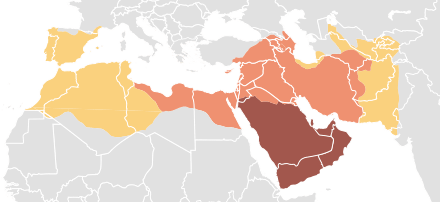
Muhammad, 622–632 CE.
Rashidun caliphate, 632–661 CE.
Umayyad caliphate, 661–750 CE
Muhammad united several of the tribes of Arabia into a single Arab Muslim religious polity in the last years of his life. With Muhammad’s death, disagreement broke out over who his successor would be.[18] Umar ibn al-Khattab, a prominent companion of Muhammad, nominated Abu Bakr, Muhammad’s friend and collaborator. With additional support Abu Bakr was confirmed as the first caliph. This choice was disputed by some of Muhammad’s companions, who held that Ali ibn Abi Talib, his cousin and son-in-law, had been designated the successor by Muhammad at Ghadir Khumm. Abu Bakr immediately moved to strike against the Byzantine (or Eastern Roman Empire) forces because of the previous defeat, although he first had to put down a rebellion by Arab tribes in an event that Muslim historians later referred to as the Ridda wars, or “Wars of Apostasy”.[208]
The pre-Islamic Middle East was dominated by the Byzantine and Sassanian empires. The Roman–Persian Wars between the two had devastated the region, making the empires unpopular amongst local tribes. Furthermore, in the lands that would be conquered by Muslims many Christians (Nestorians, Monophysites, Jacobites and Copts) were disaffected from the Eastern Orthodox Church which deemed them heretics. Within a decade Muslims conquered Mesopotamia, Byzantine Syria, Byzantine Egypt,[209] large parts of Persia, and established the Rashidun Caliphate.
 Site Title